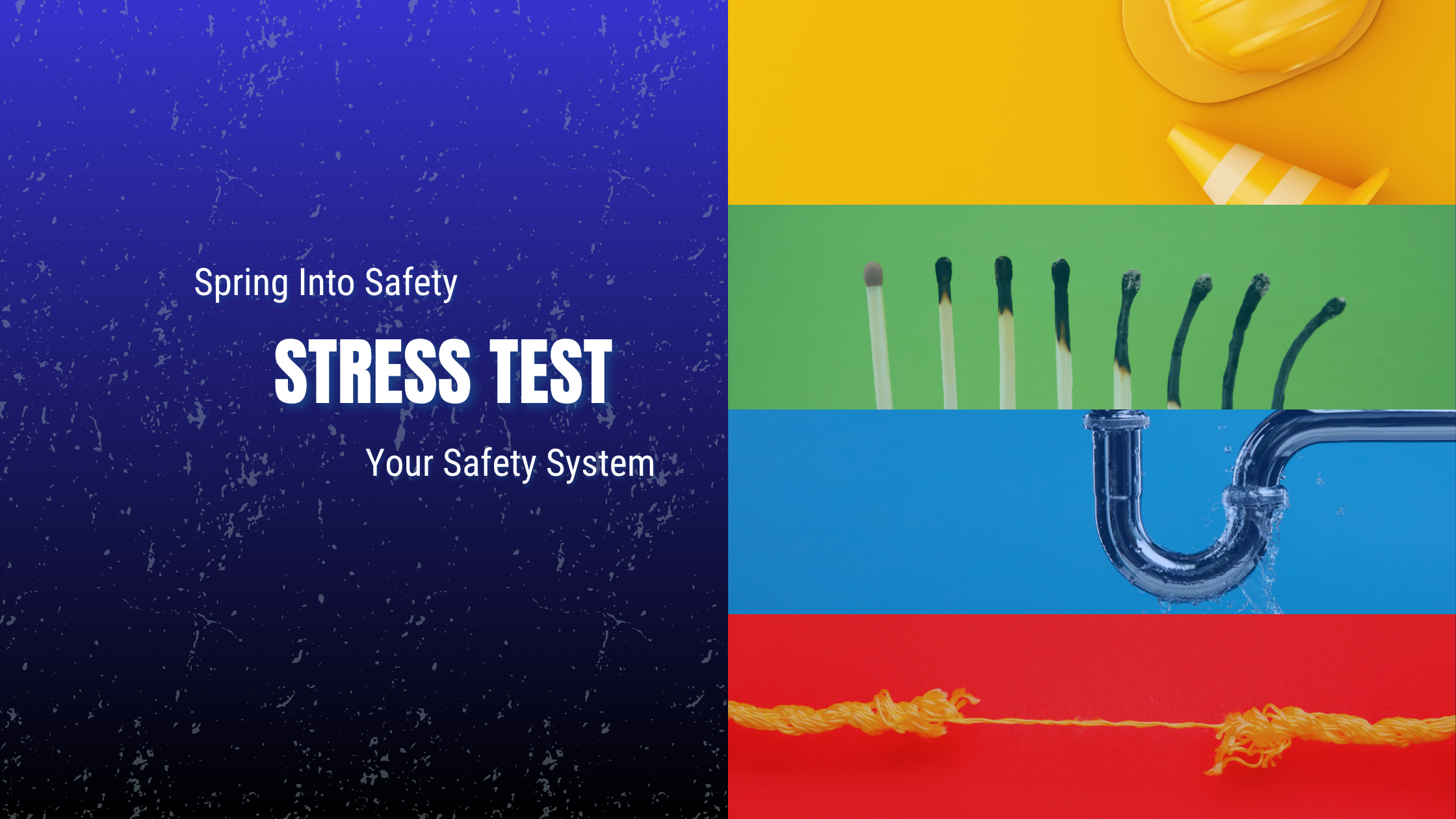
Spring Into Safety: Stress Test Your Safety System
The Spring Into Safety series explores stress as a hidden safety risk in the trades. Learn how physical strain, mental overload, burnout, and daily pressures impact safety on and off the job. In Part 1, Stress Test Your Safety System, we break down the human stress response and why managing it is critical for staying safe.
We’re willing to bet you’ve taken workplace safety training. Why? Well, it’s mandatory in Ontario under Regulation 297/13 of the Occupational Health and Safety Act (O.Reg. 297/13). And mandatory it should be.
In 2022, 264 workplace fatalities were reported across Ontario, according to Workplace Safety and Insurance Board (WSIB) statistics. More sobering still, 31% occurred in construction (that’s us) — the highest proportion of traumatic workplace deaths in the province. It’s a stark reminder of why we observe the National Day of Mourning for workplace accidents every April 28.
It’s no surprise that on-the-job safety is non-negotiable.
But most safety training focuses on hazards we can see on the job site: loose scaffolding, missing PPE, unsecured equipment. We’re taught to check the tools, machines, and systems we rely on — inspecting for visible hazards and preventing future risk.
But the job site is only part of the equation.
Some of the biggest risks workers face today aren’t visible hazards at all.
Turns out some of the most critical systems workers rely on aren’t always external.
Think about any system you work on — HVAC, refrigeration, mechanical equipment. When a system is pushed beyond its limits, performance changes. Pressure builds. Efficiency drops. Components breakdown.
We understand that the greater the unmanaged pressure, the faster the wear and tear.
But we rarely stop to consider that the same thing happens to us.
Every worker operates as a system under pressure.
Critical thinking, communication, productivity, and decision-making are all outputs of that system. Focus, judgment, reaction time, and resilience act as internal controls that keep it running safely.
When pressure builds — fatigue, stress, financial strain, distractions, media overload — it places load on the human system, and that system begins to perform differently.
Just like any mechanical system, warning signs appear before failure.
But unlike standard job site training, we aren’t always taught how to recognize those signals — what to look for, how to assess them, or how to maintain the system under pressure.
That’s what this series is about.
What This Series Covers
Over the next few months, we’ll look at how different forms of stress affect worker safety — including:
Physical Stress & PPE Evolution
Stress as the unseen safety hazard (on and off the jobsite)
Financial Stress & Pressure
Prevention & Preparation when safety systems fail (Day of Mourning)
Digital Stress & modern safety risks
Mental stress maintenance & reinforcement
Because modern safety isn’t just about hazards on the job site.
It’s about how the entire system performs under pressure.
The Invisible Hazard: Stress
Stress doesn’t stay at work. It clocks out with you and follows you home.
Without proper management, it builds pressure that impacts everything — from job performance to relationships to cognitive function.
We hear about it all the time — and we feel it.
Stress: this constant, invisible force we can’t see, and are told to avoid… in a world seemingly designed to keep us trapped in it.
For something so ever-present — impacting our health, finances, and daily decisions — it’s worth understanding how it actually works.
So consider this your crash course in the biological and emotional stress response.
Your Body, Under Stress
You detect a threat.
Lion. Tiger. Text from an ex.
Whether real or perceived, your body registers the same thing:
Danger.
From there, a complex chain reaction begins.
Your amygdala (emotional command centre) and hypothalamus (your brain/body control system) activate your sympathetic nervous system — your “on switch.”
This signals your pituitary and adrenal glands to release stress hormones like cortisol, adrenaline, epinephrine, and norepinephrine into your bloodstream.
From there:
Heart rate and blood pressure increase
Blood is redirected to muscles, brain, and vital organs
Airways expand, breathing increases
Senses sharpen
Stored sugars and fats are released for immediate energy
This is your fight-or-flight response — and it’s doing exactly what it’s designed to do: keep you alive.
When The System Resets (and When It Doesn’t)
In a perfect scenario, the threat passes and you survive unscathed.
Your parasympathetic nervous system — your “off switch” — kicks in and returns your body to a baseline state of calm.
But if the threat doesn’t go away — or keeps repeating — your system never fully resets.
Your body stays in a heightened state.
Cortisol continues to circulate. Your system remains “on.”
Short-Term vs. Long-Term Stress
Short-Term (Acute) Stress Effects:
Anxiety
Negative thinking
Poor memory or focus (scattered or fixated)
Physical and emotional tension
Behaviour changes (cravings for caffeine, sugar, nicotine, alcohol)
Most people can recover from short bursts — if the stress ends.
Chronic Stress (Long-Term Exposure)
This is where real damage begins.
Our bodies are not built to operate in fight-or-flight mode continuously.
When stress becomes constant:
Blood pressure remains elevated → increased strain on the circulatory system
Heart rate stays high → stress on the cardiovascular system
Hormonal imbalance affects metabolism overtime → insulin sensitivity, fat storage, weight gain
Sleep becomes disrupted
Decision-making and impulse control decline
Risk of mental health conditions increases
Your body may not feel all of this happening — but your systems are absorbing the load.
The Dosage: The Difference Between Medicine…and Poison
The stress response isn’t the enemy.
It’s powerful, necessary, and effective — in the right dose.
You can’t “willpower” your way out of a biologically hardwire survival response.
You don’t think, “release adrenaline” when you’re in danger — your body handles it.
But when you remove the threat → the response ends.
At least that’s the way it’s suppose to work.

The Problem: Modern Life is Constant Stimulus
Here’s where our well-oiled evolutionary systems start to break down.
Our attention is more finite than our enviorments.
Modern life is designed to keep you:
Alert
Reactive
Engaged
And during stress?
Judgment changes
Critical thinking drops
Impulse control weakens
Quick thinking, faster reactions, less second guessing. That’s useful when escaping danger.
Not so useful when scrolling for hours online in between shifts. The average North American spends 6–12 hours per day on screens, exposed to thousands of ads daily.
Our modern world knows keeping us activated and alert makes us prone to things like rash decisions like impulse purchases, sharing personal information, or reacting to that inflammatory social post. We may not be aware of it, but we’re in a near constant stimulation — and by result, constant stress activation.
Your Brain Hasn’t Caught Up
You may not be running from predators anymore.
But your brain hasn’t fully adapted.
Your amygdala still reacts like you are responding to a life-threatening danfger — whether it’s:
A deadline
A bill
A notification
A countdown timer on a shopping app
Your body doesn’t know the difference.
And because the stress response only ends when the stimulus is removed…and we rarely remove the stimulus…
The cycle repeats. Over and over again.
So What Now?
Sounds Bleak?
Yeah — a little.
But it doesn’t have to be.
Because there are effective ways to manage stress, regulate your system, and reduce the negative impacts.
And that’s exactly what this series will cover. As we inspect levels of health and safety, from physical personal protective equipment, to financial literacy, to mind-boggling media overload, we will address ways to recognize, address, and deal with stress. So your system can run a smoother for longer.
What’s Next
Want a stress-at-a-glance infographic? (Why wouldn’t you?)
Its a quick, factual summary of how your body responds to stress both biologically and emotionally, because recgonizing the signs and symptoms is the first step to being about to manage them effectively.
You can download our one-page visual reference here
And stay tuned for the next blog — where we get practical.
We’ll take a closer look at PPE on the job site and the new initiative UA Local 787 and JTAC are part of to support PPE research right here at home.